
You can spend an impressive amount of time worrying about things that will not change because you worried about them. Interest rates. Elections. What the market does before your next shift.
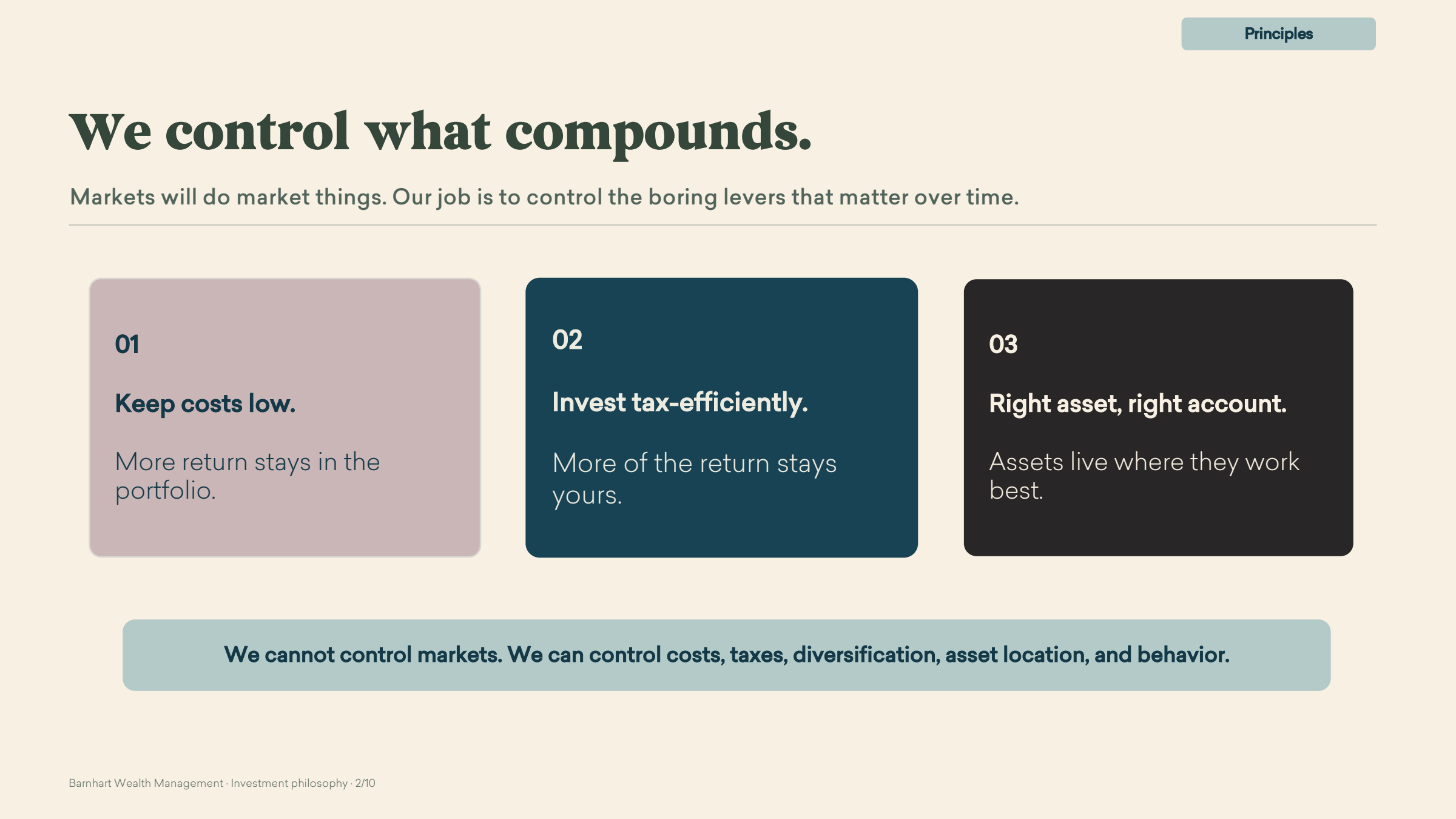
Investing gets more useful when we turn toward decisions we can actually make. How much are we paying? What are we buying? Where does it belong? How much can we save? What will we do when the account balance falls?
At On Point, those questions shape the portfolio before we discuss any particular fund.
Start with the costs you can see.
A fund expense ratio is part of the investment’s cost. Advisory fees, trading costs and other charges may add to it. A low number on one line does not tell you the whole story. The SEC’s guide to fund expenses explains the different layers.
Consider a hypothetical CRNA with $500,000 invested. A difference of 0.50 percentage points in annual fund expenses represents approximately $2,500 a year at that balance. That is arithmetic, not a forecast or a quote for our services. Actual expenses change as the balance changes.
The right question is whether each cost buys something useful. We generally start with low-cost, diversified funds and ask any additional strategy to justify its place.
Give taxes a seat at the table.
Taxes can enter the picture when an investment produces income, distributes gains or is sold. Account type matters too. A taxable brokerage account and a retirement account do not give the same investment the same tax treatment.
That is why we look at the household’s accounts together. We may hold different investments in different accounts while keeping the overall allocation aligned with the plan. The decisions depend on available investments, balances, withdrawals and the tax picture.
We also consider the cost of changing what someone already owns. Selling an appreciated holding just to make the portfolio look cleaner can create a tax bill. A gradual transition, new contributions or a different account may give us another way forward.
Choose a level of risk you can live with.
Diversification spreads exposure across investments. It cannot make an investment portfolio immune to losses. The SEC’s allocation guidance connects the investment mix with goals, time horizon and risk.
Suppose that same CRNA is saving for retirement in 25 years and a home purchase in 18 months. Both goals belong to one household. They still need different decisions. Money needed for the home should not depend on the stock market cooperating with the closing date.
Once near-term needs have a suitable home, the retirement portfolio can be evaluated on its own longer timeline. More income does not automatically justify more investment risk.
Build the behavior into the plan.
The amount you invest and the decisions you repeat are practical places to focus. Set a contribution you can sustain. Decide what will happen when income increases. Review the allocation when circumstances change.
At On Point, we use contributions, withdrawals and dividends as part of rebalancing. When trading is appropriate, we consider taxes and costs. That gives each action a reason beyond the day’s headline.
For the hypothetical household, our first work would be to separate the home money, review investment expenses and account placement, and agree on a sustainable retirement contribution. None of those decisions requires a prediction about next Tuesday.
Three questions for your own portfolio.
- Can you explain what each investment is doing?
- Do you know the costs and tax consequences of changing it?
- Does the amount of risk fit when you will need the money?
Clear answers make the portfolio easier to understand and the next decision easier to make. See how we invest for CRNAs, or use our advisor buyer’s guide to compare the help you receive.
Educational information only. The example is hypothetical. Investing involves risk, including loss of principal; costs, taxes and results vary.