
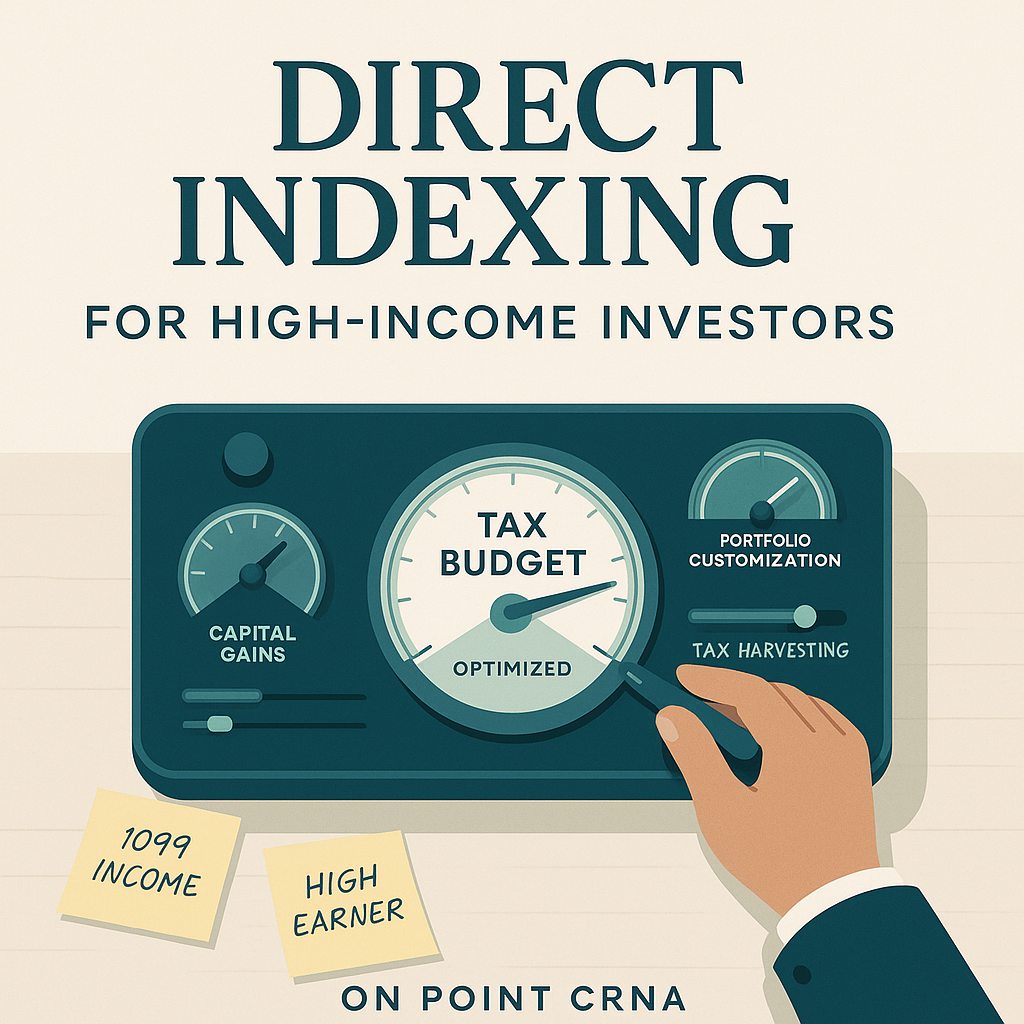
What’s Your Tax Budget?
How Direct Indexing Lets You Play Offense in a Game Most Investors Don’t Know They’re Even In
High-income professionals, especially CRNAs, physicians, and other 1099 earners, often pay more in taxes than they would like. Direct indexing can create more tax-loss harvesting opportunities by giving you control over the individual tax lots inside a portfolio. Before we unpack that, check out our guide on Safe Harbor & Estimated Payments for CRNAs to see how tax planning fits alongside variable income.
In this article, we’ll break down how direct indexing works, who it may fit, and where it can create more tax-loss harvesting opportunities than an ETF alone.
Let’s say you and I both want S&P 500-like exposure.
You’re using an ETF.
I’m using direct indexing.
We may end up with similar market exposure, but I own the underlying stocks and can manage their individual tax lots.
Here’s the real difference: both of us can tax-loss harvest. I may have more opportunities because I can sell individual positions that are down even when the overall index, and your ETF, are still up.
That’s not a free tax deduction. It’s a more granular set of tools.
For the right taxable account, that extra granularity can be useful. For the wrong investor, it can add fees, tracking error, and complexity without enough benefit.
Ready to see if direct indexing fits your tax plan? Schedule a no‑pressure consult.

ETFs Are Tax-Efficient. Direct Indexing Adds More Levers
Don’t get me wrong. ETFs are excellent. They’re usually low cost, diversified, and tax-efficient. An ETF investor can harvest a loss by selling the fund when it is below the investor’s tax basis and replacing it with a similar, but not substantially identical, fund.
The limitation is inside the wrapper. Say PayPal, Intel, and Disney decline while other holdings keep the ETF above your cost basis. You can’t sell just those losing names because you don’t own them directly.
The ETF is like a frozen burrito. If the whole burrito is below your cost basis, you can swap it. But you can’t pull out three ingredients and harvest only those losses.
Direct indexing is closer to à la carte ordering. You own the stocks directly, so you can manage individual positions and tax lots with more precision.
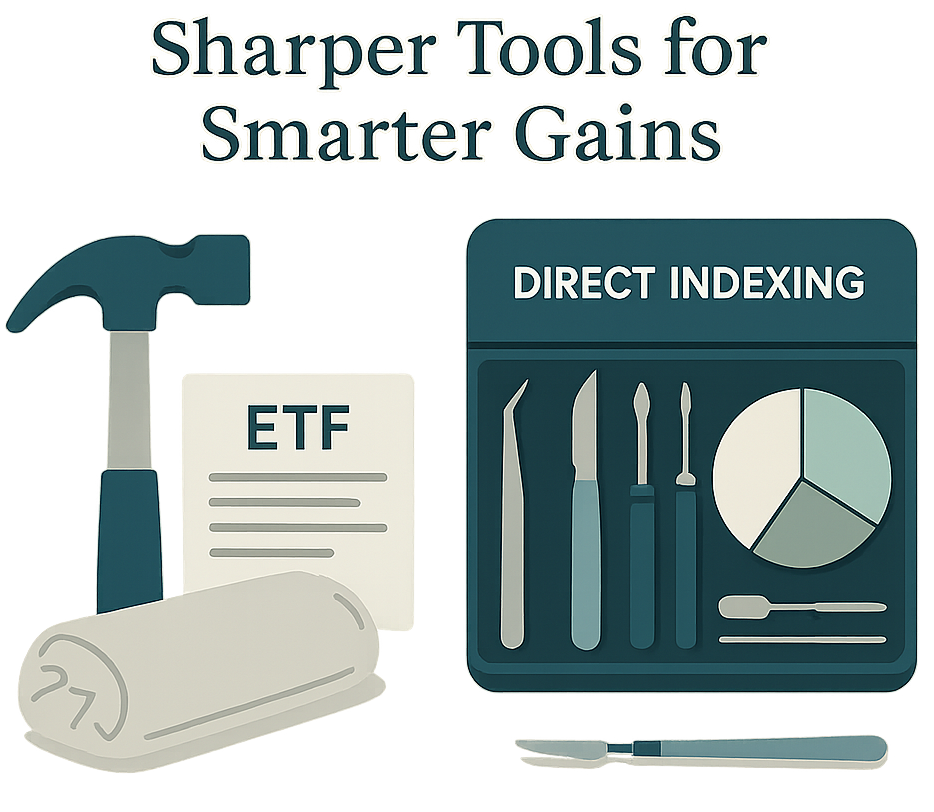
Direct Indexing: Similar Exposure, Sharper Tax Tools
Direct indexing starts with an index-like target and builds a representative basket of individual stocks, often hundreds of them.
Similar market exposure.
A familiar long-term strategy.
More flexibility inside the portfolio.
If one holding drops, you may be able to sell it, buy a similar but not substantially identical replacement, and keep your intended market exposure. Capital losses first offset capital gains. If losses exceed gains, up to $3,000 may offset other income, and unused losses can carry forward, according to IRS Topic No. 409.
That can reduce today’s tax bill, but it often defers tax rather than making it disappear. The replacement investment may carry a lower cost basis and a larger future gain.
It’s not about being clever. It’s about having more control and knowing what that control is actually worth.
Tax Alpha: Potential Value, Not a Guaranteed Bonus
Direct indexing platforms and managers use “tax alpha” to describe the potential after-tax value of systematic tax-loss harvesting. It is not a guaranteed extra return. Research published by CFA Institute found that results vary meaningfully by investor profile and market environment, including the gains available to offset, tax rates, cash flows, and what eventually happens to the portfolio.
The honest framing is simple: tax alpha is personal. The same strategy can create meaningful value for one household and mostly paperwork for another.
For a high-income CRNA with a sizable taxable account, ongoing contributions, realized gains, or exposure to the Net Investment Income Tax, direct indexing may be a useful lever to consider.
Curious what systematic tax-loss harvesting could mean in your situation? Let’s run your numbers.

The Automation Layer
Here’s where automation can help:
When I implement direct indexing for clients, we:
- Look for loss-harvesting opportunities year-round, not just at the end of December
- Reinvest in similar, but not substantially identical, securities to keep the intended market exposure
- Coordinate tax lots and other household accounts to reduce avoidable wash sales
The platform can automate a lot, but it doesn’t absolve us from paying attention. Under the wash-sale rules, purchases during the 30 days before or after a loss sale can disallow the loss. Purchases by a spouse, an IRA, or a corporation you control can matter too.
Think of it as a tax-savvy trading assistant that never sleeps, but still needs a clear job description.
Bonus?
You can customize your portfolio around personal values, exclude oil majors, add ESG filters, or avoid companies that make your skin crawl. It’s investing with intention.
Not a Magic Wand
A few trade-offs to be aware of:
- You’ll own hundreds of individual stocks. Translation: your tax forms may read more like a short novel.
- Account minimums and fees vary. I usually recommend starting around $25,000 or more, and only when the expected benefit justifies the added cost and complexity.
- There may be tracking error compared with a traditional ETF, especially when the portfolio is customized.
- Harvesting creates a lower cost basis in the replacement holdings, so the exit plan matters. A future sale can bring some of that deferred gain back into the tax return.
This strategy is not a fit for everyone. For the right investor, the benefits can be meaningful, but they are never automatic.
Who This Is Actually For
Let’s be honest. This isn’t for your friend who still has high-interest credit card debt and a Robinhood addiction.
But it may be worth a closer look if:
- You’ve handled high-interest debt and your higher-priority retirement accounts
- You’ve got $25,000 or more in a taxable account and expect to keep adding to it
- You have capital gains to offset, appreciated stock to manage, or a charitable giving strategy
- You’re willing to accept more holdings, some tracking error, and a more involved exit plan
Then yes, it’s worth a closer look. It still needs to beat the simpler ETF alternative after fees, taxes, and hassle.
Final Thought: Don’t Tip Uncle Sam More Than You Have To
There’s no medal for overpaying taxes.
No thank-you note.
No IRS agent in a suit whispering, “Wow, this one’s a patriot.”
There’s just your money… and a smarter way to manage it.
Direct indexing isn’t a magic formula or a replacement for a sound investment plan. It’s one portfolio tool. Its value depends on whether the potential tax benefit is likely to outweigh fees, tracking error, complexity, and the cost of eventually unwinding the strategy.
Curious if this strategy makes sense for your situation?
I work with high-income professionals and CRNAs to optimize taxes and grow wealth without unnecessary complexity. Let’s talk—no pressure, no jargon.
Let’s see if you’re leaving money on the table—book your free 15‑min tax check‑in.
FAQs About Direct Indexing
Q: Is direct indexing only for the ultra-wealthy?
A: Not at all. While it’s most powerful at higher account balances, it’s becoming increasingly accessible.
Q: Will this replace my current ETFs or mutual funds?
A: Not necessarily. It may be an enhancement to your taxable account strategy, not a replacement for retirement accounts or more static holdings.
Q: Do I need a financial advisor to set this up?
A: No. Some platforms support DIY direct indexing. An advisor can help when household-wide wash-sale coordination, charitable gifting, concentrated stock, or the eventual exit plan adds more moving parts.
Important Disclosure:
This content is for informational and educational purposes only and should not be considered personalized investment, tax, or legal advice. Direct indexing may not be suitable for all investors. All investing involves risk, including the risk of loss. Consult with your financial advisor or tax professional to determine whether this strategy aligns with your financial goals.
Barnhart Wealth Management (DBA On Point CRNA) is a registered investment adviser offering services in Michigan and other jurisdictions where exempt. This content does not constitute an offer or solicitation of any securities or investment advisory services.