
The 2026 CRNA retirement guide
The best plan may be both.
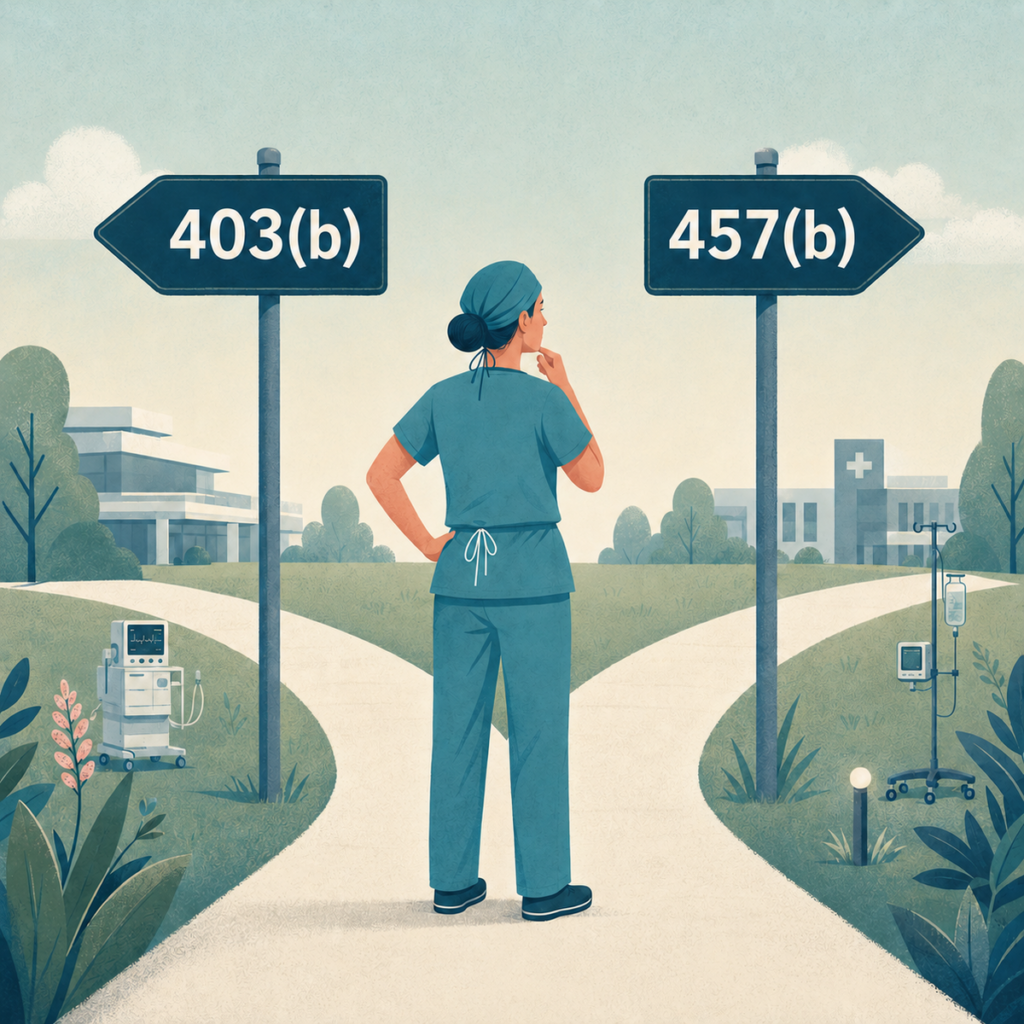
A 403(b) and a 457(b) can look nearly identical on a benefits portal. They are not. One may come with a match. The other may give you an unusually clean bridge to early retirement. If your hospital offers both, you may also have two separate contribution limits.
Eligible CRNAs may contribute this amount to a 403(b) and another $24,500 to a 457(b). That is $49,000 before employer contributions or catch-ups.
The short answer
This is usually an order-of-operations question.
A CRNA earning a hospital salary does not necessarily need to choose one plan and ignore the other. Start by capturing every dollar of employer match in the 403(b). Then compare investment costs, withdrawal flexibility, creditor risk, and your expected retirement date.
A good governmental 457(b) is often the next stop for someone targeting financial independence before age 59½. A nongovernmental 457(b) deserves a much closer look because the account may remain an asset of the employer and the distribution choices can be far less forgiving.
And if you also have 1099 income? Your Solo 401(k) employee deferral generally shares the same personal limit as your 403(b). The 457(b) limit is separate. That small technical detail can change the entire contribution strategy.
2026 contribution limits
The numbers worth knowing.
The $72,000 403(b) limit is not your salary-deferral limit. It is the broader annual-additions ceiling for employee and employer contributions combined, generally limited to 100% of includible compensation. Your normal employee deferral remains $24,500 before eligible catch-ups.
New for 2026: If your 2025 FICA wages from the plan sponsor exceeded $150,000, catch-up contributions generally must be Roth when the plan offers catch-ups under the new SECURE 2.0 rules. Your normal $24,500 deferral can still be pre-tax, Roth, or a combination if the plan allows it.
Start with the basic anatomy
Similar labels. Different jobs.
403(b)
The familiar workhorse
A 403(b) is the nonprofit and public-school cousin of a 401(k). It may accept pre-tax and Roth employee deferrals, employer matching contributions, and in some plans, additional employer contributions.
- Often the plan that receives the hospital match.
- Employer contributions do not reduce your $24,500 employee-deferral limit.
- Withdrawals before age 59½ may face the 10% additional tax unless an exception applies.
- The age-55 separation exception may help if you leave that employer during or after the year you turn 55.
- Some long-service employees qualify for a special 15-year catch-up.
457(b)
The flexible second bucket
A 457(b) is a deferred-compensation plan offered by state and local governments and some tax-exempt employers. It has its own $24,500 limit, separate from the 403(b) and 401(k) limit.
- Governmental plans generally allow penalty-free withdrawals after separation, regardless of age.
- Employer contributions generally use part of the same $24,500 annual 457(b) limit.
- Governmental and nongovernmental plans have materially different protections and rollover rules.
- Some plans offer a special catch-up during the three years before normal retirement age.
- A strong 457(b) can be a useful early-retirement bridge.
Side-by-side
What actually changes the decision.
| Question | 403(b) | Governmental 457(b) | Nongovernmental 457(b) |
|---|---|---|---|
| 2026 base limit | $24,500 employee deferral | $24,500 total annual limit | $24,500 total annual limit |
| Employer contribution | Generally does not reduce the employee’s $24,500 limit, but counts toward annual additions | Generally counts toward the same $24,500 limit | Generally counts toward the same $24,500 limit |
| Age-50 catch-up | $8,000 if allowed | $8,000 if allowed | Generally not available |
| Ages 60 to 63 catch-up | $11,250 if allowed | $11,250 if allowed | Generally not available |
| Access after leaving | 10% additional tax may apply before 59½ unless an exception applies | Generally no 10% additional tax on plan-originated dollars after separation | Distribution timing depends heavily on the plan election |
| Can it roll to an IRA? | Generally yes after an eligible distribution | Generally yes, but doing so can sacrifice unique penalty-free access | Generally no rollover to an IRA or qualified plan |
| Creditor exposure | Plan assets generally held for participants | Assets generally held in trust for participants | Assets generally remain subject to the employer’s creditors |
The part most CRNAs care about
Yes, you may be able to max both.
The 403(b) employee-deferral limit and the 457(b) limit are separate. If both plans permit the contributions and your compensation supports them, a CRNA under age 50 could contribute $24,500 to each in 2026.
This is different from holding a 403(b) at the hospital and a Solo 401(k) for locum income. The employee deferrals to the 403(b), 401(k), and Solo 401(k) generally share one personal $24,500 limit. The 457(b) sits in a separate bucket.
Run your 2026 contribution room
How much could the two plans hold?
This assumes both plans allow the selected contribution features.
This screening tool does not test compensation limits, prior unused 457 deferrals, prior use of the 403(b) 15-year catch-up, nondiscrimination limits, another employer’s plan, plan-specific caps, or the tax benefit of pre-tax versus Roth contributions. Employer 403(b) contributions may also affect the $72,000 annual-additions limit.
Do not skip this question
Is the 457(b) governmental?
Governmental 457(b)
These plans are generally offered by state or local government employers. Assets are generally held in trust for participants. Eligible distributions can usually be rolled to an IRA or another eligible retirement plan.
The early-access feature is also unusually valuable. After separating from service, distributions of plan-originated dollars generally avoid the 10% additional tax, even if you are younger than 59½.
Nongovernmental 457(b)
These plans may be offered by tax-exempt hospitals and health systems. The promise to pay is generally unsecured, and plan assets remain available to the employer’s general creditors.
Distribution elections can also be restrictive and may become difficult to change after separation. These plans generally cannot roll to an IRA. Read the plan document before making a large deferral or leaving the employer.
A hospital’s nonprofit status does not answer the question. Ask the benefits team whether the 457(b) is governmental or tax-exempt nongovernmental, then request the plan document and distribution-election rules.
Catch-ups without the alphabet soup
Three rules people tend to mix together.
Age 50+
For 2026, the standard catch-up is $8,000 for a 403(b) and governmental 457(b) if the plan allows it. A nongovernmental 457(b) generally does not use the age-50 catch-up.
Ages 60 to 63
The higher SECURE 2.0 catch-up is $11,250 in 2026. This replaces the $8,000 catch-up for the applicable plan and year. It is not stacked on top of it.
Special 457 catch-up
During the three years before the plan’s normal retirement age, the plan may allow up to twice the basic limit or the basic limit plus eligible unused prior deferrals. You use this or the age-based catch-up, not both.
403(b) 15-year rule
Some plans permit up to $3,000 more for employees with at least 15 years at the same eligible employer, subject to a $15,000 lifetime cap and a formula based on prior deferrals.
Roth catch-up
Beginning in 2026, catch-up contributions generally must be Roth when prior-year FICA wages from that employer exceeded $150,000. The plan’s administration and Roth feature matter.
Plan permission
The tax code may permit a contribution that your employer’s plan does not offer. The summary plan description gets the final vote.
A practical contribution order
Where should the next dollar go?
-
Capture the full 403(b) match
Do not sacrifice a guaranteed employer contribution while debating whether one fund menu is 0.08% cheaper than another. Take the full match first.
-
Fund the HSA when it fits the health plan
For many high-income CRNA households, the HSA is one of the most tax-efficient accounts available. It can sit ahead of unmatched workplace-plan contributions when cash flow allows.
-
Compare the unmatched 403(b) with the 457(b)
Review investment fees, annuity costs, surrender restrictions, employer stability, access after separation, and whether the 457(b) is governmental. The account label alone does not tell you which is better.
-
Coordinate any locum retirement plan
Your 403(b) and Solo 401(k) employee deferrals generally share the same $24,500 limit. Employer contributions to a Solo 401(k) may still create additional room. The 457(b) remains separate.
-
Choose pre-tax versus Roth intentionally
Many CRNAs are in a high marginal bracket while working, which can make pre-tax contributions attractive. Roth can still help with future tax diversification, pensions, required distributions, and unusually low-income years.
Common planning misses
The expensive mistakes are usually boring.
Missing the 403(b) match
The 457(b) may be more flexible, but it rarely compensates for voluntarily leaving employer money on the table.
Treating every 457(b) the same
A governmental plan and a nongovernmental plan may share a name while carrying different creditor, rollover, and distribution risks.
Rolling a governmental 457(b) too quickly
An IRA may offer better investments, but the rollover can give up the 457(b)’s special pre-59½ withdrawal treatment.
Overfunding across jobs
A hospital 403(b) and a locum Solo 401(k) do not each receive a separate employee-deferral limit. Payroll systems do not coordinate this for you.
Ignoring the investment menu
A plan full of expensive annuities, surrender charges, or high-cost funds can eat into the tax benefit. Compare all-in costs, not just contribution limits.
Waiting until the last paycheck
Salary deferrals must run through payroll. If the final payroll closes before the election changes, the unused room does not magically reappear in April.
Frequently asked questions
403(b) and 457(b) questions from CRNAs.
Can I contribute $24,500 to a 403(b) and another $24,500 to a 457(b) in 2026?
Potentially, yes. The 403(b) employee-deferral limit and 457(b) limit are separate. Your compensation, plan terms, employer contributions to the 457(b), and catch-up eligibility can change the exact amount.
Does my Solo 401(k) get a separate $24,500 limit from my hospital 403(b)?
Generally, no. Your employee deferrals to 401(k), Solo 401(k), and 403(b) plans share one personal limit across employers. The employer-contribution side of the Solo 401(k) follows different rules and may create additional room.
Why is a governmental 457(b) useful for early retirement?
After separating from the employer, distributions of dollars that originated in the governmental 457(b) generally are not subject to the 10% additional tax that can apply before age 59½. Ordinary income tax still applies to pre-tax distributions.
Should I roll my governmental 457(b) to an IRA when I leave?
Not automatically. An IRA may offer better investment choices and easier administration, but rolling the account can eliminate the governmental 457(b)’s special penalty-free access before age 59½. Compare both features before moving the money.
How do I know whether my hospital’s 457(b) is governmental?
Ask the benefits department for the summary plan description and whether the plan is a governmental 457(b) or a tax-exempt nongovernmental 457(b). Do not rely only on the hospital being nonprofit.
Do employer contributions reduce what I can put into the 457(b)?
Generally, yes. Employer and employee contributions to a 457(b) usually share the same annual limit. That differs from a 403(b), where an employer match generally does not reduce the employee’s elective-deferral limit.
Are all catch-up contributions Roth in 2026?
No. The new Roth requirement generally applies when your prior-year FICA wages from the employer sponsoring the plan exceeded $150,000. Participants below the threshold follow the plan’s available pre-tax and Roth options.
Which plan should I max first after receiving the match?
Compare the 457(b) type, investment expenses, withdrawal rules, employer stability, and your expected retirement age. A low-cost governmental 457(b) often deserves priority for an early-retirement goal. A nongovernmental plan requires more scrutiny.
One decision, several moving parts
Make the plans work together.
The best answer depends on more than the contribution limit. We coordinate the hospital plans, locum income, taxes, investments, and retirement timeline so the next dollar has a specific job.
Primary sources
- IRS: 2026 retirement-plan contribution limits
- IRS: 403(b) contribution limits and catch-ups
- IRS: IRC 457(b) deferred-compensation plans
- IRS: Deferrals when eligible for more than one retirement plan
- IRS: 2026 catch-up and Roth catch-up rules
This article and calculator are for educational purposes only and are not individualized tax, investment, legal, or financial advice. Plan documents, compensation, employer contributions, prior deferrals, employment status, age, and future tax law can change the result. Confirm contribution elections and deadlines with the plan administrator and professionals familiar with your circumstances.