
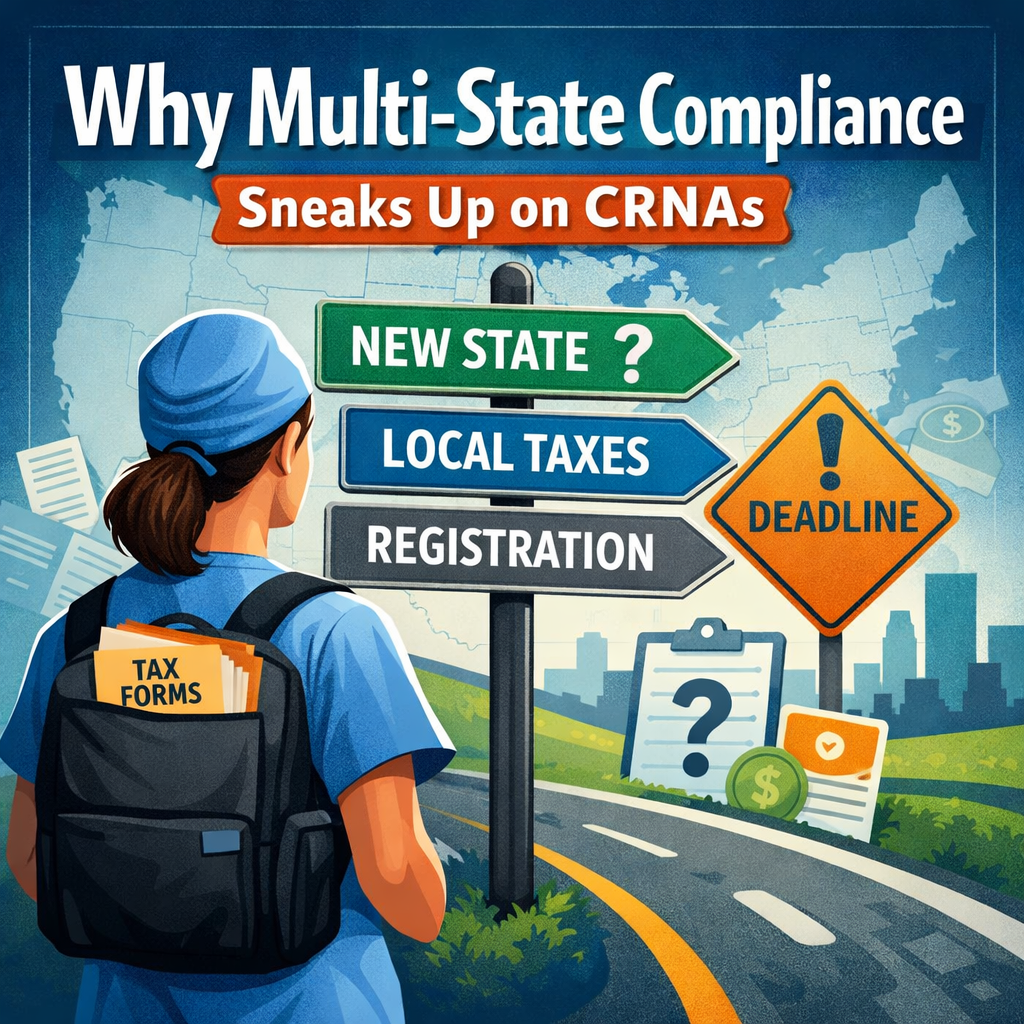
Working in multiple states? Cool. Let’s make sure your paperwork doesn’t try to ruin your life.
Alright, so you pick up a few out-of-state shifts, the pay is great, you feel like a genius… and then April shows up with a stack of “friendly” letters.
Multi-state work can create multi-state tax + payroll compliance issues, especially if you’re 1099, running an S-Corp, or bouncing between assignments.
We help you get organized, get registered where needed, and stay compliant… all without drowning in state portals and guesswork.
Quick note: This is guidance + implementation support. Every situation is different, and state rules vary. We’ll help you build a clean plan and coordinate the moving parts.
If any of this is you… you’re in the right place
You’ll probably want a multi-state compliance plan if you:
- Work locums / travel assignments in more than one state
- Are 1099 (or a mix of W-2 + 1099)
- Have an S-Corp and payroll (or you’re supposed to…)
- Keep thinking, “Wait… do I need to file in that state if I was only there 6 shifts?”
- Want to avoid the classic April ritual: rebuilding your year from memory and calendar screenshots
What “multi-state compliance” actually means (in plain English)
When you physically work in multiple states, it can trigger requirements like:
- State income tax filings (sometimes nonresident returns)
- Withholding considerations (depending on how you’re paid and the state rules)
- Entity registrations / payroll accounts (often relevant for S-Corps and payroll setups)
- Better tracking so you can allocate income correctly and avoid “we’ll just guess” tax prep
The goal isn’t to make this complicated.
The goal is to make it boring.
Because boring compliance is beautiful.
Payroll did its job. That doesn’t mean the state(s) are done with you.
Some of the most common conversations I have with CRNAs start the same way:
“I was only there for a few weeks.”
“They withheld state taxes, so I thought it was handled.”
Those are reasonable assumptions… and they’re also exactly why multi‑state issues tend to blindside smart, diligent people.
Because payroll can be correct and you can still have state/local compliance obligations sitting outside of payroll—quietly, patiently, waiting to pop up later like an old chart you forgot to sign.
If you’ve worked (or plan to work) in multiple states, especially as a locum, we can help you identify what applies and build a simple system so nothing important gets missed.
Get Help With Multi‑State Compliance
Where the confusion comes from
When payroll is set up correctly, it does what it’s designed to do:
- Paychecks go out
- Wages get reported
- Payroll tax filings happen
- Withholding happens based on the information provided
From the outside, that looks “complete.”
What isn’t obvious is that some state and local requirements are not payroll tasks.
Working in another state can trigger obligations that have nothing to do with how your paycheck was processed. Things like:
- Registering an existing business/entity to operate in a new state
- County or municipal tax rules that don’t show up on a pay stub
- Administrative filings and compliance steps that live in state portals, not payroll systems
These aren’t payroll “mistakes.” They’re simply not payroll’s job.
Why this doesn’t always show up right away
I often hear: “We did this before and nothing happened.”
Sometimes that’s true… until one year it isn’t.
A slightly longer assignment, higher income, a different county, or a state-specific rule can quietly change what’s required. And when something gets missed, it often shows up months later, after the contract is over and you’ve moved on.
That delay is what makes it feel so unexpected.
Why locum CRNAs feel this more than most
Locums work is flexible (which is the whole point), but it also creates some built-in blind spots:
- Short, high-pay assignments across multiple states
- Different agencies handling different pieces
- No central HR department tracking anything beyond payroll mechanics
None of this is intuitive. And none of it reflects a lack of diligence.
It’s just a system with gaps.
What “multi-state compliance” can actually look like
One reason this topic is so frustrating is that “multi‑state compliance” can mean different things in different places.
In some cases, it really is simple—something like registering an existing entity to operate in another state.
In other cases, it can include:
- State-specific administrative filings
- Waiting periods or approval timelines
- Local/county requirements unrelated to professional licensing
- Decisions about whether it makes sense to maintain an entity long-term in more than one state, transition operations, or simplify
And sometimes agencies request certain entity structures for their own risk-management reasons—even when the state licensing rules don’t require them. That disconnect can create another layer of confusion: what’s truly required vs. what’s being requested.
There’s no one-size-fits-all answer. The right approach depends on:
- Where the work is performed
- How long the assignment lasts
- How you’re structured (W‑2, 1099, S‑Corp, etc.)
- What ongoing obligations each option creates
Payroll handles this. Payroll does not handle that.
This is where expectations matter.
Payroll typically handles:
- Reporting wages
- Filing payroll tax returns
- Withholding based on the information provided
Payroll typically does not handle:
- State or local business registrations
- County/municipal tax obligations
- Non-tax compliance triggered by where the work is performed
- Entity-level requirements that live outside the paycheck process
That’s where we come in.
How we help
Our role is to monitor what exists outside of payroll.
We connect the dots across states, assignments, and local rules so nothing important gets overlooked—then we help you put a simple process in place so you’re not reinventing the wheel every time you cross a border for a contract.
What that looks like in real life:
- Identifying the likely compliance touchpoints created by your multi-state work
- Clarifying what’s truly required vs. what’s “requested”
- Coordinating the plan with your tax professional and/or payroll provider (if applicable)
- Building a tracking system so you can prove where you worked and when (instead of guessing later)
What you get (deliverables, not vibes)
When you work with us on multi-state compliance, we build a plan you can actually follow:
1) A Multi-State Compliance Roadmap
A simple, state-by-state checklist that answers:
- What needs to happen
- Who does it (you, us, payroll provider)
- When it needs to happen
- What to track going forward
2) Account + Registration Coordination (as needed)
Depending on your setup, we’ll help coordinate things like:
- State agency accounts that need to exist (so you’re not improvising later)
- Payroll-related registrations if your structure requires them
- “Order of operations” so you don’t create new problems while fixing old ones
3) A Tracking System That Doesn’t Rely on Your Memory
You’ll get a clean way to track:
- Travel/assignment notes you’ll actually thank yourself for later
- Workdays by state
- Income by state
Common outcomes (the wins people actually care about)
Clients typically walk away with:
- Fewer surprises at tax time
- Less “did I mess this up?” anxiety mid-year
- Cleaner bookkeeping and cleaner returns
- A plan we can repeat each year, even if assignments change
FAQs
Maybe—maybe not. It depends on the state, your residency, your income type, reciprocity rules (where applicable), and how much you worked there. The safe move is to have a tracking system and a clear decision process instead of guessing.
That’s exactly where people get tripped up—small amounts are easy to forget, but they can still matter. We’ll help you build a clean rule-of-thumb process and coordinate specifics with your tax prep as needed.
Very common. The compliance and tracking approach changes based on pay type. We’ll map it out clearly so you’re not mixing rules.
Both. It can create tax planning opportunities, but it also adds compliance steps (especially if payroll is involved). The biggest issue we see is not the S-Corp itself—it’s missing the setup details and discovering it the hard way.
Pricing depends on things like:
-Number of states
-Your entity/payroll setup
-Whether this is proactive planning vs. cleanup after the fact
-If you want, we’ll quote it after the intake so it’s accurate and fair.
-Also fair warning – we do not offer this as a standalone service. Please see our pricing page.
Final perspective
Multi-state compliance isn’t about worrying more. It’s about awareness.
When someone is intentionally watching what happens beyond payroll, issues tend to stay small—or never show up at all.
The goal is:
- fewer surprises
- less cleanup
- and confidence that your flexibility isn’t quietly creating problems behind the scenes
If this raises a question—or if you’re unsure how a recent assignment might affect you—reach out. We’re happy to help you think it through before it turns into something bigger.
Further reading (if you like to nerd out)
Educational info only. You should consult a qualified tax and/or legal professional for guidance specific to your situation. State rules vary and can change.