

CRNA pay & financial freedom
Rising CRNA pay can put more money in your pocket. What you do next determines whether it also gives you more control over your life.
There’s a strange thing about being in demand: it can leave you with less free time.
Another opening. Another extra shift. Another opportunity to make very good money doing work that matters. Eventually, a strong job market can start feeling suspiciously like a calendar with no empty squares.
As a financial advisor married to a CRNA, I care about both sides of that equation. The paycheck matters. So does having a life that doesn’t require saying yes to every staffing request.
The opportunity right now is to turn your professional value into lasting options. That might mean higher pay, a better schedule, less debt, or enough invested wealth to be pickier about the next contract.
The pay story is real. The comparison matters.
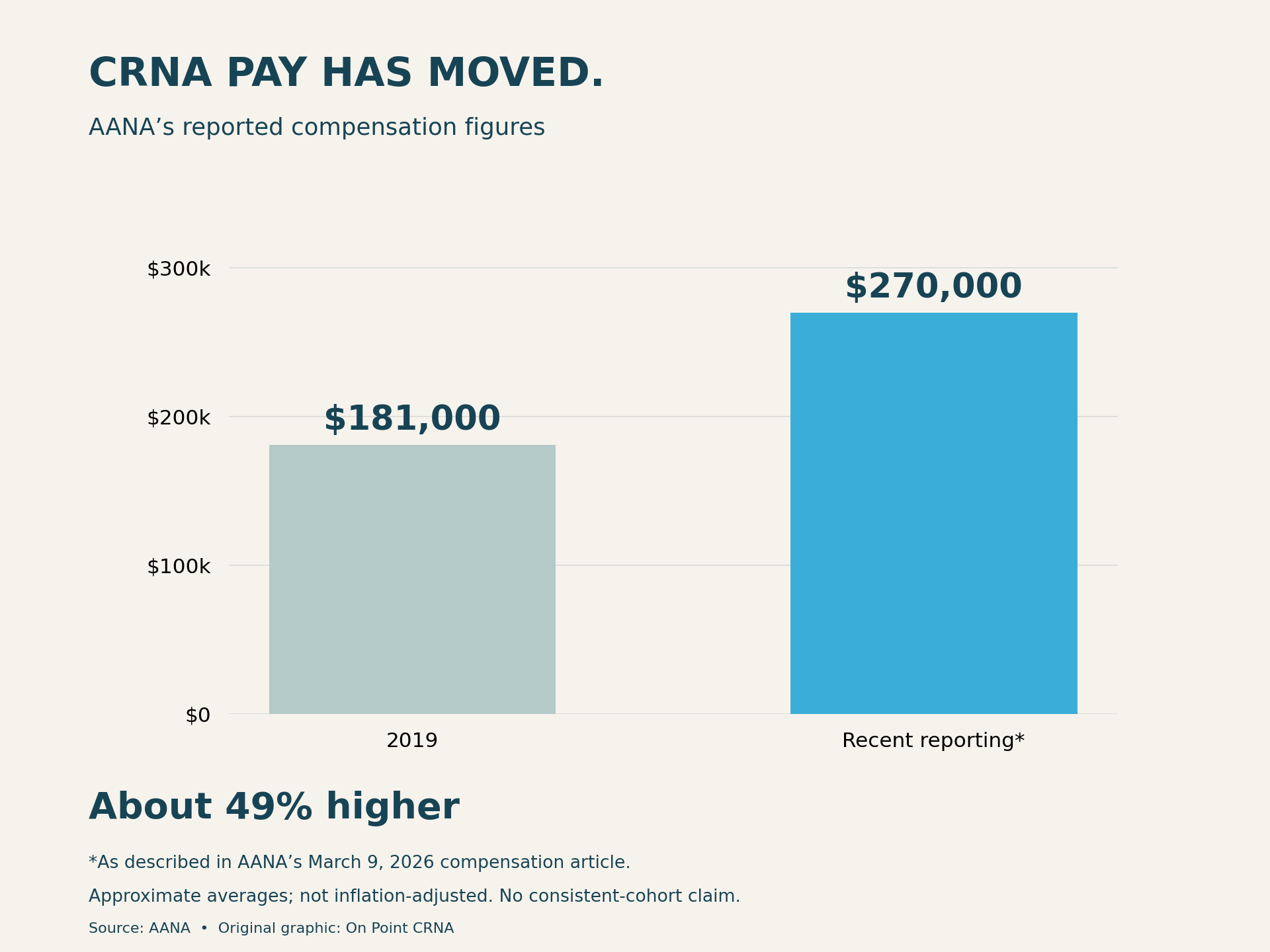
AANA’s March 2026 compensation discussion cites average compensation of roughly $181,000 in 2019 and $270,000 in recent reporting. That’s an increase of about 49%, before adjusting for inflation.
Marit’s original article reported $288,441. Its live salary page, marked updated September 19, now displays $295,368. That is a dated snapshot of its peer-reported compensation data, not a promise about your next offer. Explore Marit’s CRNA salary data.
Meanwhile, the Bureau of Labor Statistics reports a $236,590 median annual wage for nurse anesthetists in May 2025. Its wage data exclude self-employed workers.
Why three different numbers? They measure different populations, periods, and forms of pay. A median is the middle observation; an average can move with unusually high or low submissions. Marit’s methodology describes voluntary submissions, clinician identity checks, statistical screening, and weighting. These remain self-reported benchmarks, so compare the workload and employment terms behind them.
Use benchmarks to ask better questions. Match geography, hours, call, experience, employment type, and benefits before deciding you’re underpaid. A high number with six more weekends attached deserves a little context.
What’s driving CRNA pay and demand?
Anesthesia coverage reaches well beyond the OR.
Endoscopy, interventional radiology, and other procedural settings need coverage too. A 2023 Anesthesia Patient Safety Foundation consensus report projected that nonoperating-room anesthesia could exceed 50% of all anesthesia cases in the near future. That was a projection, not a measured 2026 share or a guaranteed 2030 deadline.
The practical point: when you evaluate a market, look beyond one hospital’s operating rooms. Ask where cases are moving, which facilities are expanding, and what skills those settings need.
Training takes years, even when the pipeline grows.
AANA lists 155 accredited programs as of March 2026, with programs lasting 36 to 51 months. You can’t fill next month’s schedule by increasing next fall’s class size.
But the pipeline is growing. NBCRNA’s 2025 report counted 3,294 first-time certification-exam candidates, up from 2,740 in 2024, an increase of about 20%. Candidates are not the same as newly practicing CRNAs, but this is a useful reminder that supply is responding.
National demand and local negotiating power are different things.
The BLS projects 10% growth in nurse-anesthetist employment from 2025 to 2035, compared with 3% for all occupations. Separately, AANA reports that CRNAs represent more than 80% of anesthesia providers in rural counties. BLS employment outlook · AANA rural-practice facts
Those numbers help explain why the profession matters. They don’t tell you what one employer can afford, whether a particular contract will renew, or how safely a facility is staffed.
A hard-to-fill role may pay more for good reasons. Find out what they are before you volunteer to become the solution.
Negotiate the life attached to the paycheck.
Higher CRNA pay is useful. So are predictable hours, protected vacation, reasonable call, and a shorter commute. Your strongest offer may include some combination of all five.
Before accepting a new position or renewing a contract, put the full package on one page:
| Look at | Ask this |
|---|---|
| Reliable income | What is guaranteed, and what depends on extra hours, call, or productivity? |
| Time | How many working weeks, nights, weekends, and recovery days does the pay require? |
| Benefits & costs | Who pays for insurance, retirement contributions, malpractice, licensing, and continuing education? |
| Exit terms | What happens to a signing bonus, tail coverage, or notice obligation if you leave? |
AANA reports that roughly 80% of CRNAs are being offered signing bonuses, with average amounts around $20,000. It also flags repayment obligations. A bonus with a lengthy clawback deserves to be read with the same enthusiasm as the dollar amount.
If you’re weighing W-2 against 1099, compare annual economics at the same workload. Contractor revenue still has to cover the costs and benefits you now own. The IRS explains the income-tax, self-employment-tax, and estimated-payment responsibilities that can accompany self-employment.
This is where coordinated advice earns its keep: a contract review with an attorney, a tax projection, and a cash-flow comparison can all inform the same decision before you sign.
What could another $20 an hour actually change?
Let’s give the opportunity a job.
Suppose you negotiate an additional $20 per hour while keeping the same employment arrangement, benefits, expenses, and schedule: 36 paid hours per week for 46 weeks.
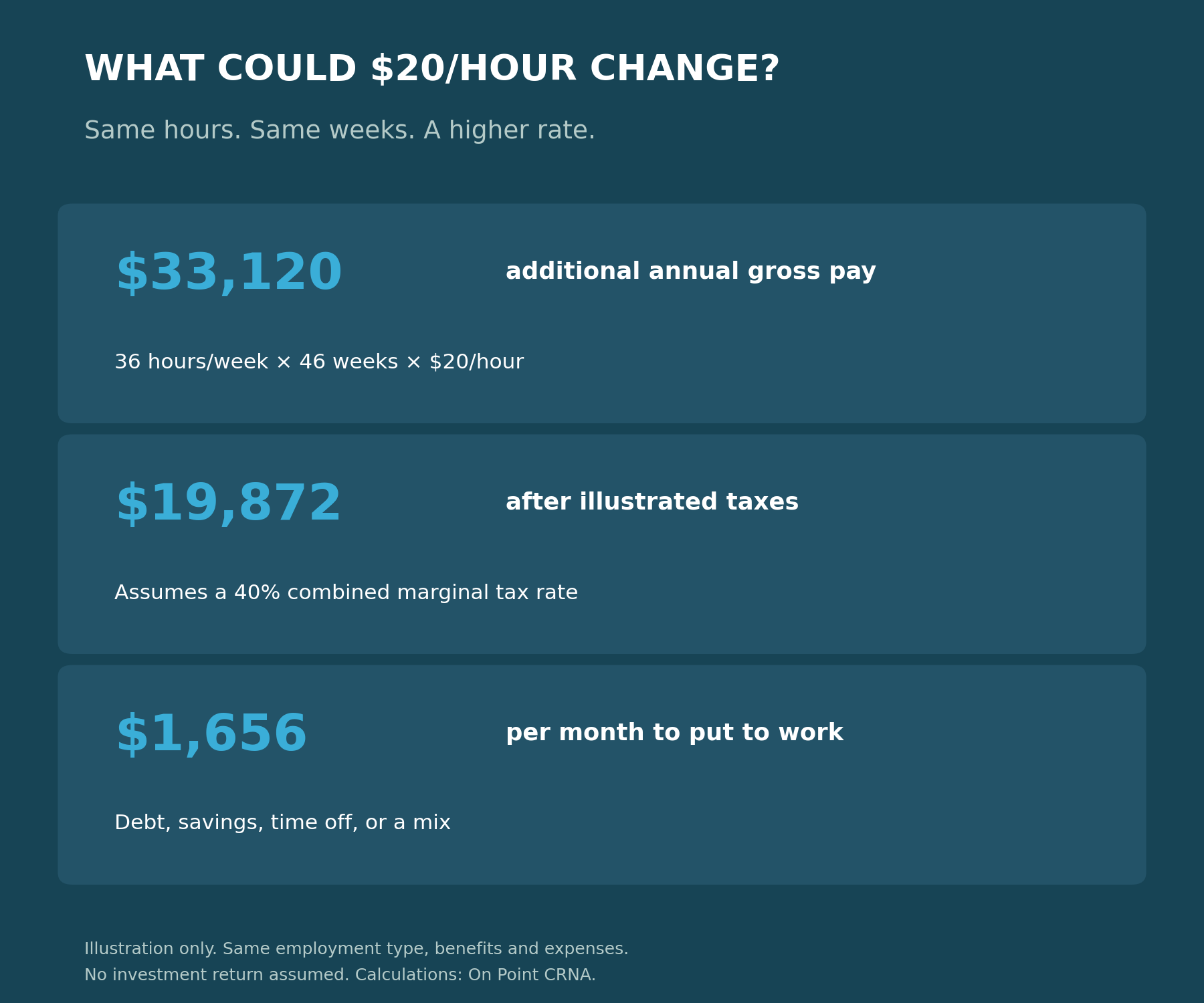
The arithmetic is straightforward: $20 × 36 × 46 = $33,120. Keep 60% after the assumed taxes and you have $19,872 per year, or $1,656 per month.
Your actual result requires a tax projection. A change in benefits, business expenses, retirement contributions, or employment type changes the comparison.
Now choose what happens to that money. You could send $828 a month toward long-term savings and leave $828 for enjoying life today. Or direct the entire amount toward a student loan, a cash reserve, or a future reduction in hours.
Save the full illustrated amount for ten years and your contributions alone total $198,720. That assumes the same raise, hours, and tax rate each year. No investment growth is included; inflation would reduce its purchasing power.
The raise creates the opportunity. The automatic transfer makes sure it doesn’t quietly become a car payment and three subscriptions you forgot about.
Build a plan that survives a quieter job market.
I wouldn’t build a permanent lifestyle around the highest locums rate you’ve ever seen. Strong demand can coexist with a canceled assignment, a contract change, or a stretch when you simply need to work less.
Start by separating reliable income from extra shifts and temporary incentives. Decide which expenses the reliable income must cover. Then give the variable dollars specific jobs.
For a W-2 CRNA, that might mean increasing savings when a raise lands. For a 1099 CRNA, it might mean funding taxes and business reserves before moving money into the household account. For someone already saving well, it might mean calculating whether less call or fewer shifts would still leave the plan on track.
And protect the earning ability behind all of it. Review disability coverage, cash reserves, and the practical consequences of time away from work. Being in demand doesn’t make you immune to needing a break.
You don’t have to maximize income forever to make good use of this market. You need to decide what the income is supposed to accomplish.
Marit’s reporting is a helpful starting point for understanding the market. Bring that information into your next compensation conversation. Then bring the offer into your financial plan.
The best outcome may be a larger paycheck. It may also be a Tuesday you don’t have to work.
Sources, credit & a note on the numbers
With thanks to Dr. Rob Anderson, Sandy Lewis, CRNA, and Marit Health for the May 28 article that prompted this discussion. Visit their original piece for its reporting and visuals. This is independent On Point CRNA commentary; attribution does not imply their endorsement.
- Marit CRNA salary benchmarks and methodology. Live data checked September 22, 2026; salary page marked updated September 19. Figures may change.
- AANA: 2026 contracts and compensation. Approximate pay figures and signing-bonus context. The 49.2% calculation uses $270,000 ÷ $181,000 − 1; it is not inflation-adjusted.
- BLS Occupational Outlook Handbook. May 2025 CRNA median wage and 2025–2035 occupation-specific employment projection. Wage and employment measures differ from membership and self-reported compensation datasets.
- AANA education facts and rural provider facts; NBCRNA 2025 NCE/SEE report, printed page 2. First-time candidates rose 20.2%, calculated as 3,294 ÷ 2,740 − 1.
- APSF NORA consensus report (2023), by John Beard, Emily Methangkool, Shane Angus, Richard D. Urman, and Daniel J. Cole. Its 50% figure is a projection.
- IRS: Self-employed individuals tax center. The $20/hour example is our illustration, not a survey result or projected investment return.
Both graphics are original On Point CRNA designs using the sources and assumptions identified above.