

Retirement-rich can still feel cash-poor.
Qualified Term, or Qt, shows how many years of your current Term spending are represented by your tax-advantaged accounts. It is useful because it tells you where your wealth lives, not because it predicts the date you can retire.
A high Qt can be a sign of disciplined saving. It can also be a reminder that the money for next year’s home project, career change, or tax bill should probably live somewhere easier to reach.
What Qualified Term actually measures
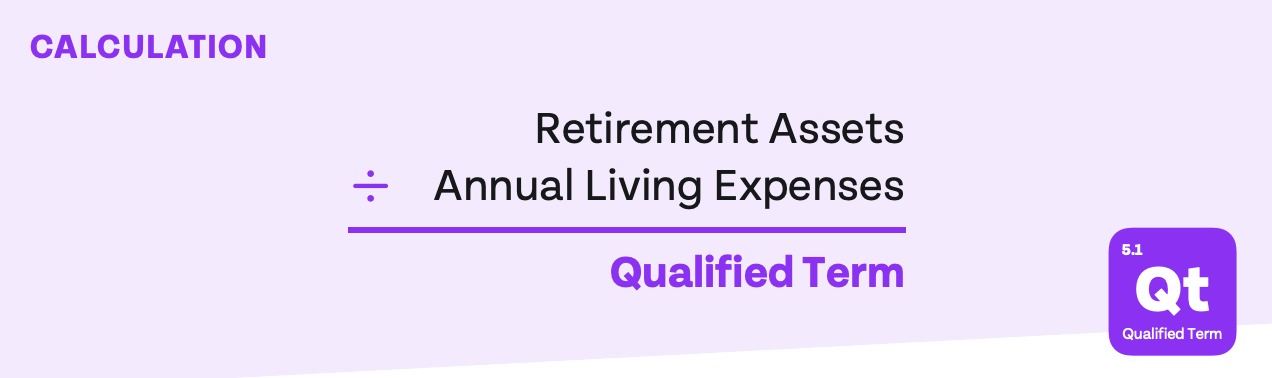
Qualified Term estimates how many years your current lifestyle could be represented by assets held in tax-advantaged accounts. The calculation freezes everything in place. It assumes no additional contributions, no investment growth, no inflation, and no change in spending.
That makes Qt a snapshot, not a retirement projection. It is one useful reading that still needs the context of liquidity, taxes, debt, and the rest of the balance sheet.
Your Qualified Term calculator
Add the current balances in the tax-advantaged accounts you want included, then enter annual Term spending. That means personal living expenses plus required debt payments, excluding income taxes and transfers to savings.
Educational estimate only. Account classification can vary by ownership and purpose, and the calculation does not model taxes, penalties, growth, inflation, future contributions, Social Security, pensions, or withdrawal sequencing.
Your selected tax-advantaged assets equal about 5.1 years of the Term spending entered.
Qualified does not mean identical.
Within the Elements framework, Qt groups tax-advantaged assets together so you can evaluate the concentration of your wealth. That is helpful, but the accounts inside the bucket still follow very different rules.
Employer retirement plans
Traditional and Roth 401(k)s, 403(b)s, governmental 457(b)s, profit-sharing plans, and defined benefit plans may all contribute to the qualified side of the picture.
IRAs and self-employed plans
Traditional and Roth IRAs, SEP IRAs, SIMPLE IRAs, and retirement accounts connected to a Solo 401(k) can increase Qt.
Health Savings Accounts
HSAs are tax-advantaged and often invested for future medical costs. They are valuable, but qualified medical withdrawals follow different rules from retirement-plan withdrawals.
Other purpose-specific accounts
Elements includes 529 plans, annuities, and minor retirement accounts in this bucket. Their purpose, access rules, ownership, and tax treatment still matter.
The important distinction: Qt does not mean every dollar is available to fund normal living expenses today. Roth IRA basis, HSA reimbursements, governmental 457(b) withdrawals, annuity surrender schedules, and education accounts all play by different rules. The score groups the assets for planning. It does not erase the fine print.
Qualified Term changes with age and the rest of the plan.
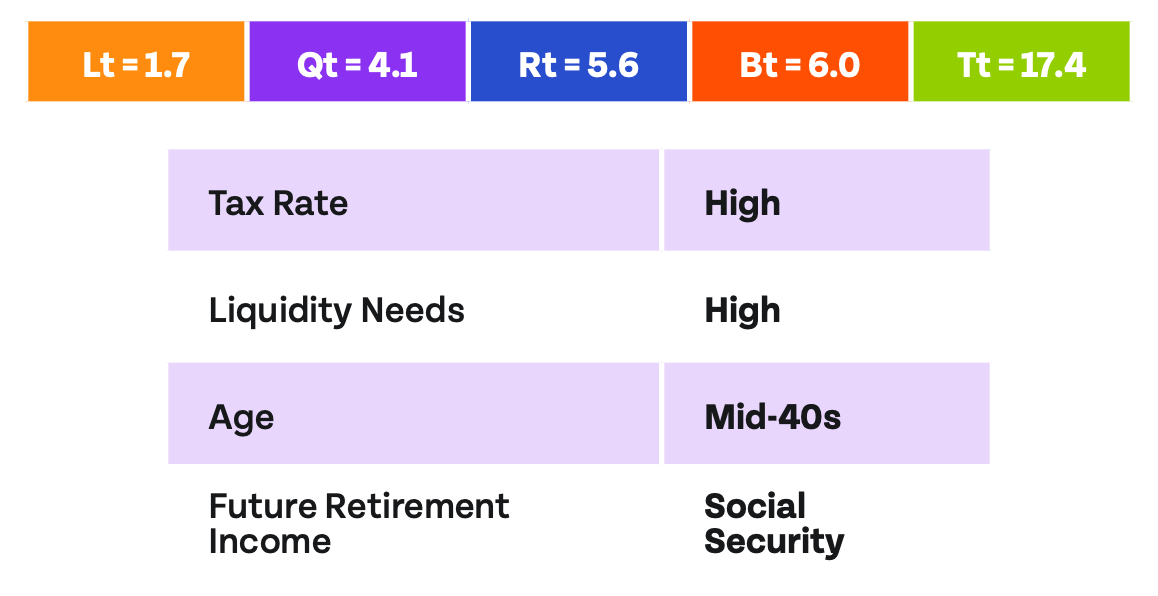
Elements publishes age-based reference ranges for Qt. They are useful context, not universal targets. Tax rate, pension income, retirement timing, business ownership, liquidity needs, and near-term goals can all support a household-specific target.
| Age | Low | Typical | High |
|---|---|---|---|
| Under 35 | Below 0.25 | 0.25 to 2.0 | Above 2.0 |
| 35 to under 45 | Below 0.5 | 0.5 to 5.0 | Above 5.0 |
| 45 to under 55 | Below 2.0 | 2.0 to 7.0 | Above 7.0 |
| 55 to under 65 | Below 3.0 | 3.0 to 10.0 | Above 10.0 |
Elements does not publish a 65-and-older range in its current Quick Reference, so this article does not invent one.
Qt makes more sense beside the other Terms.
A good Qualified Term does not rescue poor liquidity. A large brokerage account does not replace retirement savings. The useful answer comes from seeing how the buckets work together.
Liquid Term
How many years of spending are represented by cash, brokerage assets, and other liquid resources? This is the part of the plan that usually provides flexibility before retirement age.
Qualified Term
How much of your financial life is stored in tax-advantaged accounts? Qt helps reveal whether you are underusing retirement accounts or leaning on them so heavily that nearer-term goals are getting squeezed.
Total Term
How many years of spending are represented across the broader balance sheet? This is the widest view, but it can include assets that are illiquid, taxable, restricted, or expensive to access.
CRNA income can hide an unbalanced plan.
A strong income makes it possible to save aggressively, but it also makes it easier to overfund whichever account happens to be sitting directly in front of you.
A hospital-employed CRNA may max a 403(b) every year while carrying very little outside the plan. A 1099 CRNA may build a large Solo 401(k) while forgetting that quarterly taxes, unpaid time off, a vehicle replacement, and a future practice transition all require liquid cash. A household with both W-2 and locums income can have even more moving parts.
| What the pattern looks like | What it may be telling you | What to review next |
|---|---|---|
| Low Qt, low Liquid Term | The issue may be the savings rate itself, not account selection. | Start with cash flow, debt priorities, and a sustainable automatic savings target. |
| Low Qt, strong Liquid Term | You may have flexibility but be underusing employer plans or self-employed retirement options. | Review the match, tax bracket, plan fees, and whether more of the annual savings belongs in tax-advantaged accounts. |
| High Qt, thin Liquid Term | You may be building retirement wealth at the expense of near-term flexibility. | Price the next three years of taxes and known goals before increasing payroll deferrals again. |
| Strong Qt and Liquid Term | The balance may be healthy, but the job is not finished. | Review asset allocation, beneficiaries, tax diversification, investment costs, and the purpose assigned to each account. |
More room does not automatically mean “fill every bucket.”
For 2026, the employee deferral limit for 401(k), 403(b), and governmental 457(b) plans is $24,500. The usual age-50 catch-up is $8,000, while participants ages 60 through 63 may be eligible for an $11,250 catch-up if the plan permits it. The IRA limit is $7,500, plus a $1,100 catch-up at age 50 or older. HSA limits are $4,400 for self-only coverage and $8,750 for family coverage, plus a $1,000 catch-up beginning at age 55.
Those limits create opportunity. They do not create an obligation. The right contribution order still depends on employer matches, plan quality, marginal tax rate, debt, insurance, upcoming purchases, business cash needs, and how much liquidity already exists.
High-income employees also need to account for the 2026 Roth catch-up rule. If prior-year FICA wages with the sponsoring employer exceeded $150,000, catch-up contributions generally must be Roth when the plan offers catch-ups and a Roth feature.
Five years is a number. The balance sheet tells the story.
Assume a CRNA household has $400,000 in a 401(k), $100,000 in Roth IRAs, $10,000 in an HSA, and annual Term spending of $100,000. Their Qualified Term is 5.1 years.
That result is neither automatically good nor bad. If the household also has $140,000 of cash and taxable investments, stable employment, and no large purchases ahead, the mix may be perfectly reasonable. If they have $12,000 in cash, a $60,000 tax bill coming, and plans to cut back clinical hours, the same 5.1 Qt tells a very different story.
The calculation did not change. The decision did.
Three steps are enough.
Clean up the inputs
Update every account balance and calculate annual Term spending from actual outflows. Separate personal living expenses and required debt payments from taxes and savings.
Compare the buckets
Review Qt beside Liquid Term, Total Term, and your Savings Rate. The contrast is usually more useful than the score by itself.
Assign the next dollar
Decide whether the next dollar belongs in the employer plan, a 1099 retirement plan, an HSA, a brokerage account, cash reserves, debt reduction, or an upcoming goal. Account selection comes after purpose.
Questions CRNAs usually ask first
What is a good Qualified Term score?
There is no universal target. Age, career stage, tax rate, pension income, business ownership, liquidity needs, and upcoming goals all affect what a healthy Qt looks like. The trend and the balance among your other financial vitals matter more than chasing one benchmark.
Does a Qt of 10 mean I can retire for 10 years?
No. Qt ignores investment returns, inflation, taxes, penalties, Social Security, pensions, health costs, future contributions, and the withdrawal rules attached to each account. It is an asset-concentration metric, not a retirement-income plan.
Should Roth accounts count even though Roth IRA contributions may be accessible?
They may still be classified within the qualified bucket for the Elements score, but Roth access rules matter when making an actual decision. The metric groups assets. Your financial plan should still distinguish Roth IRA basis, earnings, employer-plan Roth dollars, age, and holding periods.
Why would a 529 or HSA be included if it is not retirement money?
Elements groups these tax-advantaged, purpose-specific accounts on the qualified side of the balance sheet. That classification does not make the dollars interchangeable. Education and medical accounts still need to be matched to the goals they were built to fund.
Should a 1099 CRNA use a SEP IRA or Solo 401(k) to improve Qt?
Possibly, but the account should fit the business. Contribution flexibility, employee eligibility, payroll, Roth access, backdoor Roth planning, costs, and administrative complexity all matter. Our SEP IRA versus Solo 401(k) guide walks through the tradeoffs.
Can W-2 and locums CRNAs contribute to more than one retirement plan?
Often, yes, but the limits do not all stack the same way. A 401(k), 403(b), and Solo 401(k) generally share one employee-deferral limit, while a governmental 457(b) may provide a separate deferral limit. Employer contributions and controlled-business rules add another layer. Coordinate the plans before running the December payroll scramble.
Your score is the start of the conversation.
On Point CRNA coordinates financial planning, investments, and proactive tax strategy around the way CRNAs actually earn, save, and live.
Primary references: Elements Qualified Term Assessment Guide, Elements Financial Vitals Quick Reference, IRS 2026 retirement-plan and IRA limits, IRS catch-up contribution guidance, and IRS 2026 HSA limits.
Last reviewed for 2026 rules in July 2026. This article is educational and does not provide individualized investment, tax, or legal advice.